Stop Directing Interviews, Start Discovering Stories (Corporate Film Method)
Jan 12, 2026The Art of Interviewing: From Corporate Scripts to Human-Centered Stories
Why the most powerful corporate films don’t start with questions, they start with listening.
Creating human-centered corporate films starts with one thing: authentic interviews. Not polished sound bites. Not perfectly crafted answers. Real conversations that allow people to speak like human beings.
Yet most corporate interviews don’t fail because people aren’t authentic. They fail because we try to control the conversation instead of discovering the story.
This article expands on the ideas explored in the video above and dives deeper into why interviewing is not a technical task, but an art form, one that sits at the foundation of meaningful corporate filmmaking.
Interviewing is not a transaction
In many corporate environments, interviews are treated like transactions. The goal becomes extracting approved messaging as efficiently and safely as possible. Scripts are written. Answers are predetermined. The interviewee is asked to perform.
The problem is that human connection does not survive this process.
The moment someone shifts into performance mode, something subtle changes. Body language tightens. Eye movement becomes fixed. The person stops thinking and starts delivering. Even if the words are correct, the connection is gone.
Great interviews don’t come from asking better questions. They come from creating conditions where people feel safe enough to reveal something real.
The shift from scripting to discovery
Early in my career, I worked extensively in highly regulated corporate environments where scripting was non-negotiable. The intention made sense: protect the brand, control the message, avoid risk.
But after years of directing scripted interviews, one thing became impossible to ignore. The results were sterile. Cold. Technically correct, but emotionally empty.
The breakthrough didn’t come from changing lighting, lenses, or camera placement. It came from one simple moment when an interviewee said, “I wish we could just have a conversation.”
When we filmed both versions, scripted and conversational, the difference was undeniable. Even compliance departments could see it. The conversational version wasn’t risky. It was effective.
Preparation without questions
One of the most common fears around unscripted interviews is the idea of losing control. In reality, control doesn’t disappear, it simply shifts.
Instead of controlling words, you control the environment. Instead of controlling answers, you control the pace. Instead of controlling the narrative in advance, you control it in the edit.
This means preparation still matters, just not in the form of a question list. Real preparation happens before you ever press record:
- Setting expectations with the client
- Building trust before the first question
- Designing a physical space that feels safe
- Removing unnecessary pressure from the subject
Curiosity replaces scripting. Listening replaces directing. And surprisingly, the stories that emerge are often stronger than anything you could have written in advance.
Protecting the person, not forcing the moment
One of the biggest misconceptions about emotional interviews is that the goal is to “get emotion.” It’s not.
The goal is to create an environment where emotion is allowed, not extracted.
Sometimes that means leaning in. Sometimes it means pulling back. Sometimes it means changing direction entirely to protect the person in front of you.
A powerful moment is only powerful if it’s ethical. The responsibility of the interviewer isn’t to push, it’s to read the room and respond with empathy.
The question that reveals everything
At the end of every interview, I ask the same question:
“Is there something I haven’t asked you that you think is important?”
Sometimes it reveals new information. Other times it creates a beautifully natural summary of the entire conversation. Either way, it reinforces something essential:
The best interviews aren’t found on paper. They’re found in the moments between the questions.
Interviewing as a cinematic discipline
Interviewing sits at the intersection of psychology, storytelling, and cinematography. Light, framing, body language, pacing, and listening all work together.
When you approach interviews as an art, not a transaction, your corporate films stop feeling like content and start feeling like stories.
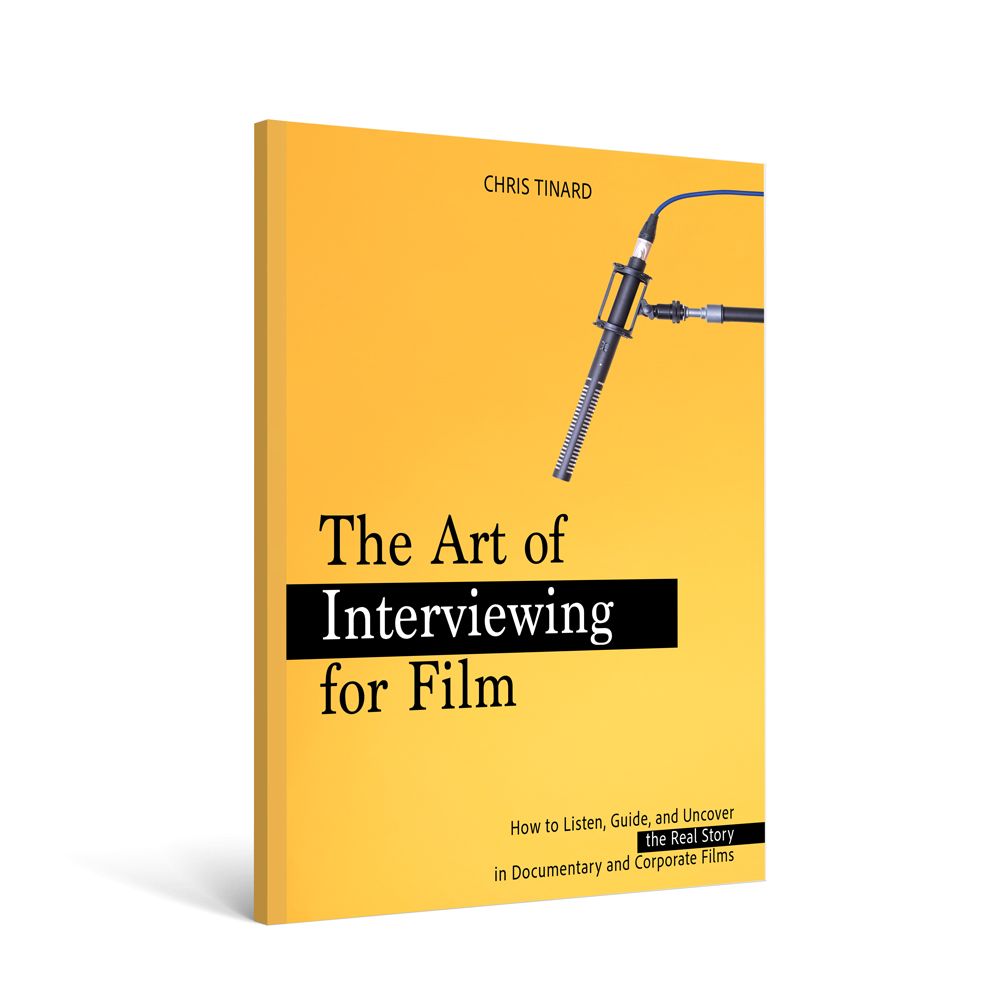
If this approach resonates with you, I’ve put everything I’ve learned over the last two decades into a guide called The Art of Interviewing.
It’s normally available for purchase on Amazon, but you can download it for free using the link below.
Download The Art of Interviewing (Free Guide)
Inside, I break down how to:
- Capture real conversations on camera
- Earn trust quickly
- Stay on brand without scripting people into something they’re not
- Build interviews that support strong cinematic storytelling
by Chris Tinard © cNOMADIC 2026
Learn more about intentional cinematography and filmmaking at cNOMADIC.com