I Finally Found a Travel Light for My Favorite Setup
Jul 21, 2026I Finally Found a Travel Light for My Favorite Setup
The most valuable travel light is not simply small. It solves a real production problem without creating a new one.
When I first started using a lantern for corporate B-roll, it quickly became one of my favorite lighting setups.
I loved the soft, natural light it created. More importantly, I loved how easily it could illuminate several people interacting within the same space.
The problem was travel.
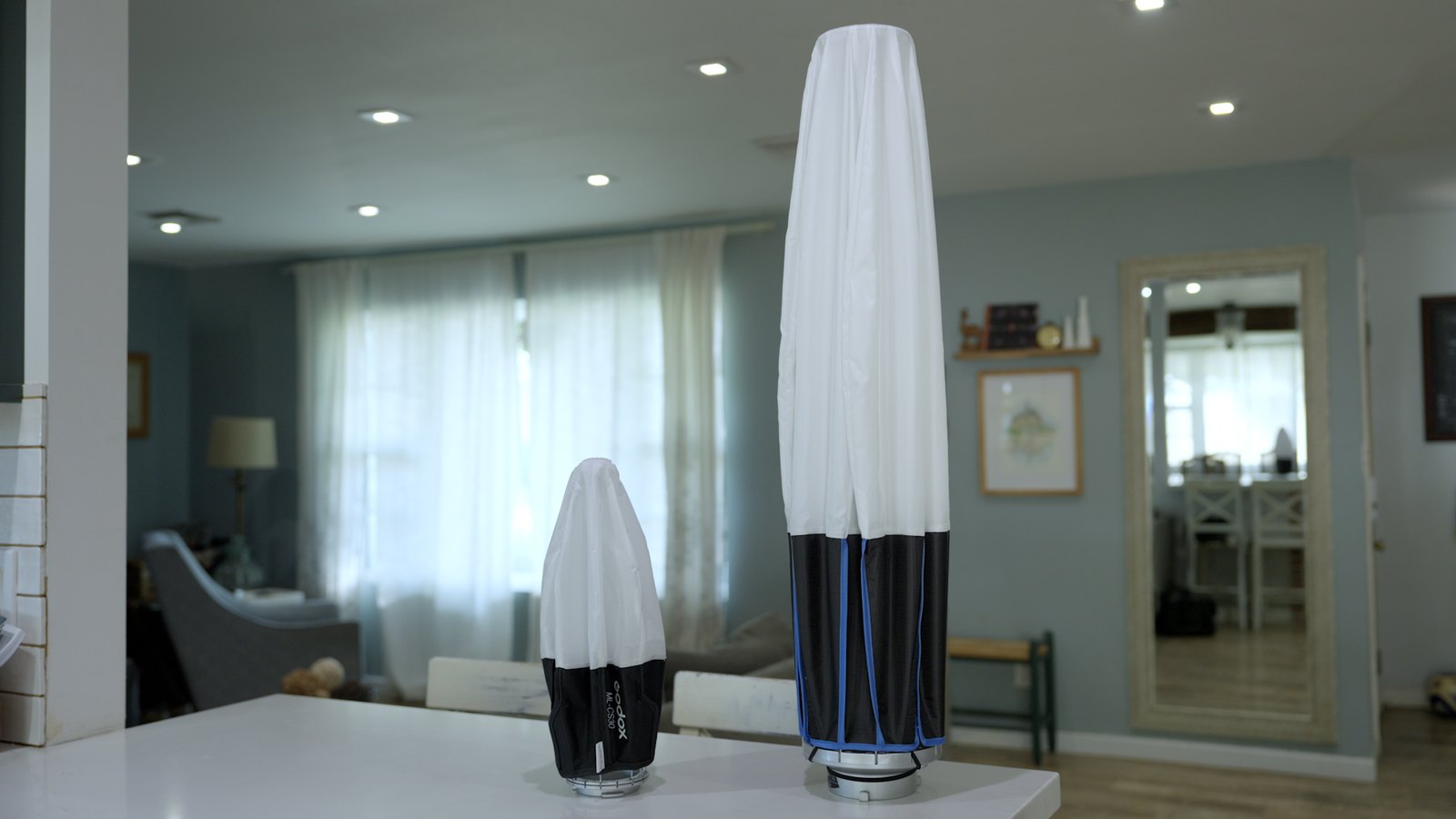
Most lanterns take up far more room than you would expect. Even when the diffusion collapses, the internal structure remains long and difficult to pack. The smallest options I found were often taller than the tripods I already carried.
That made them useful in the studio, but unrealistic for the kind of corporate filmmaking I do on the road.
I also needed a fixture that was lightweight enough to hang safely from the compact boom arm and travel stands already in my kit. I do not travel with heavy-duty stands or a collection of sandbags, so every additional pound matters.
When I came across the Godox ML40R and its compact ML-CS30 lantern, I wanted to see whether this tiny system could finally solve both problems.
Could it give me the soft, consistent light I had come to love without taking over my travel kit?
Why lanterns work so well for corporate B-roll
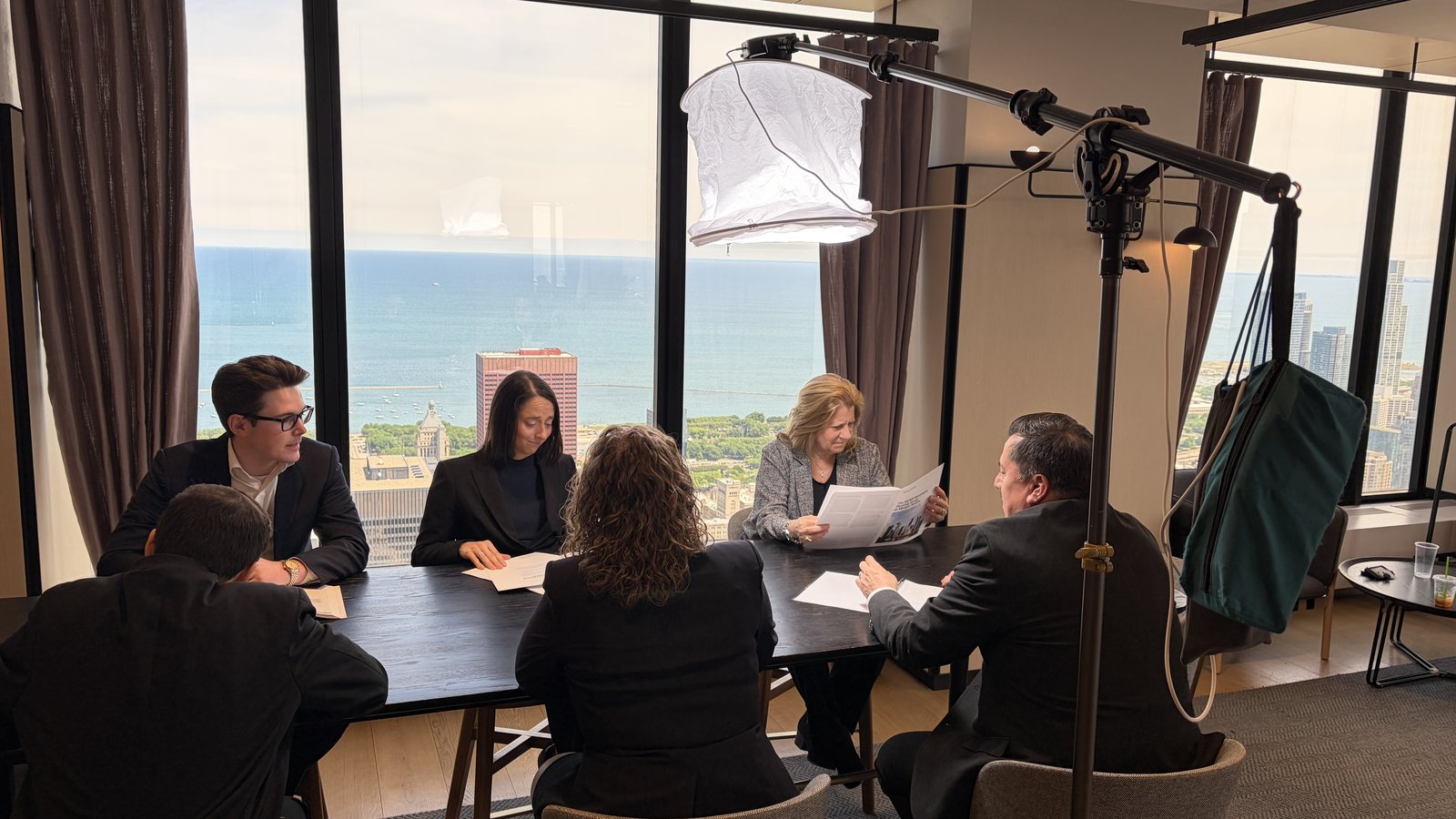
One of the most difficult corporate B-roll situations is filming several people interacting around a table.
You might begin with a wide shot, move around the group for individual angles, and then capture over-the-shoulder shots, reactions, hands, and details.
With a traditional softbox, the light is directional. That can look beautiful from the original camera position, but the quality of the light begins to change as the camera moves.
One person may have a strong key side. Another may end up with the light behind them. A third may suddenly appear flatter or darker than everyone else.
The usual solution is to move the light with the camera.
That works technically, but it slows the shoot and can make the lighting feel inconsistent. The direction of the light changes every time the camera changes position. What should feel like a natural interaction begins to look like several separately lit setups.
A lantern approaches the problem differently.
Because it spreads light throughout the space, it can illuminate everyone around the table at the same time. It also puts light onto the table itself, helping the environment feel connected to the people inside it.
Most importantly, the lighting remains consistent as the camera moves.
I can capture a wide shot, walk around the table, and move into individual coverage without rebuilding the lighting for every angle.
That consistency is what made the lantern so useful.
Soft light does not have to mean flat light
One concern with lanterns is that they will flood the entire room and eliminate contrast.
That was not my experience.
The lantern created soft illumination across the group, but the direction and distance still mattered. A person facing toward the center of the table received more light on the side closest to the source, while the opposite side of the face retained shape and contrast.
The light felt soft without becoming completely flat.
That distinction is important.
Soft light describes the transition between light and shadow. It does not mean that every surface needs to have the same brightness.
By controlling the height, position, distance, and intensity of the lantern, I could create a natural-looking environment while still preserving dimension in the faces.
The result felt less like a film light had been positioned for each person and more like the room itself had a believable source of illumination.
The travel problem
Once I knew I wanted to use lanterns more often, I began looking for a version I could bring on location.
That is where the idea started falling apart.
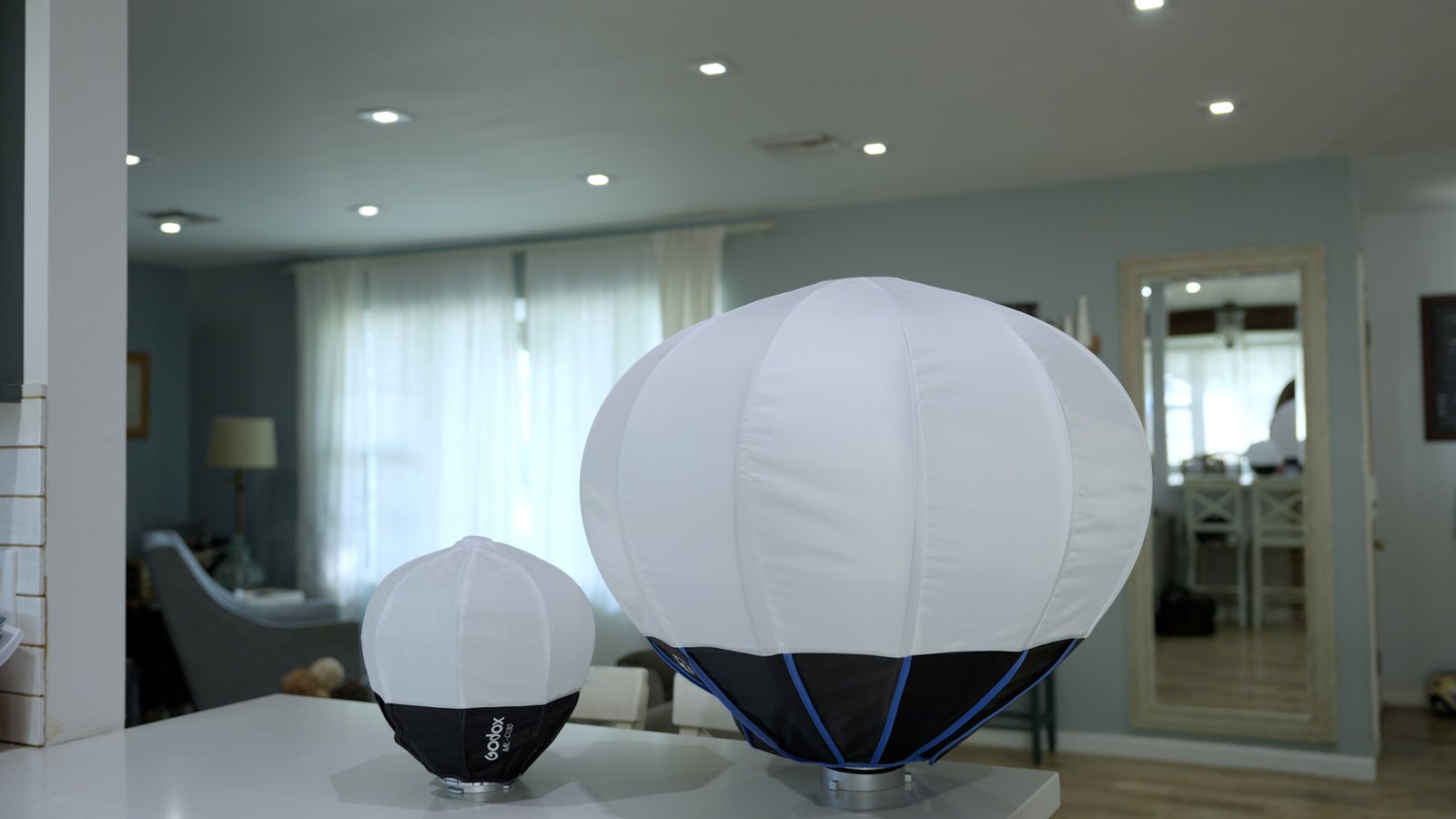
A normal softbox collapses into a relatively compact shape. A lantern often contains a long metal structure that does not reduce nearly as much. Even small lanterns can become awkward pieces of equipment to pack and protect.
The modifier was only half the problem.
I also needed a light that was powerful enough to be useful, light enough to hang overhead, and versatile enough to justify the space it occupied.
My travel stands are intentionally lightweight. I carry one compact boom arm and do not normally bring sandbags. A large fixture would require a larger support system, and that larger support system would defeat the purpose of building a compact kit.
The light, modifier, stand, boom, power solution, and counterweight all have to be considered as one system.
A compact fixture is not truly travel-friendly if it forces you to carry three additional pieces of heavy support equipment.
Why the Godox ML40R caught my attention
The first thing I noticed about the ML40R was its size.
It is easily the smallest professional light fixture I own. The body is compact enough to hold in one hand, and without a modifier it weighs approximately one pound.
What surprised me was that it initially felt heavier than it looked.
The reason is that the fixture has powerful magnets built into the body. Those magnets allow the light to attach directly to suitable metal surfaces.
That immediately opened up possibilities beyond the lantern setup.
I often film corporate stories inside factories, warehouses, and other industrial environments. I have mounted cameras to forklifts and machinery in the past. Being able to place a small light on an appropriate metal surface could create a fast solution for adding an edge light, illuminating a detail, or working inside a space where a stand would be inconvenient.
The ML40R also includes a built-in battery and can be charged or powered through USB-C. That removes the need for a separate battery mount and keeps the rig compact.
Godox added a simple lockout behavior to prevent the light from accidentally turning on inside a case. You have to rotate the control wheel before the fixture unlocks.
It is a small design choice, but it solves a very real travel problem. The last thing you want is to arrive on location and discover that the light turned itself on inside your bag and drained the battery.
One small light, several different tools
The ML40R is the full-color version of the fixture. It offers a wide color-temperature range, RGB control, lighting effects, onboard controls, and app control.
That already makes it more versatile than a light designed for one specific purpose.
The included ML-L10 lens reflector changes its character even further.
Without the lens, the bare fixture produces a broader, softer source. With the lens attached, the beam becomes much narrower, harder, and significantly more intense.
In my test, the reading increased from approximately 97 foot-candles without the modifier to roughly 1,500 foot-candles with the lens.
That is a dramatic change from such a small fixture.
The light can go from gently lifting a small area to creating a sharp, concentrated beam for a more dramatic image.
Godox also makes the ML-GB Bowens-mount adapter. That adapter allows the ML40R to work with many of the Bowens-mount modifiers I already own.
Now the fixture is not limited to its dedicated accessories. I can use a softbox, reflector, projection-style modifier, or other Bowens accessory when the situation calls for it.
The value is not just that the light is small.
The value is that the same small fixture can perform several very different jobs.
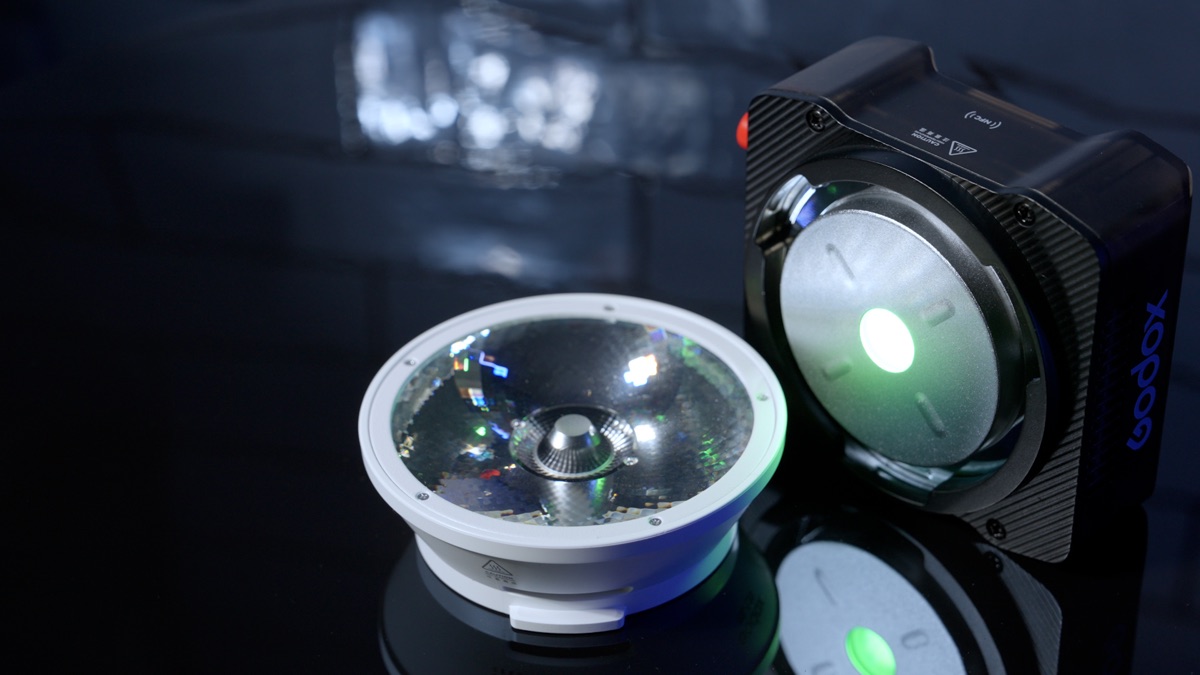
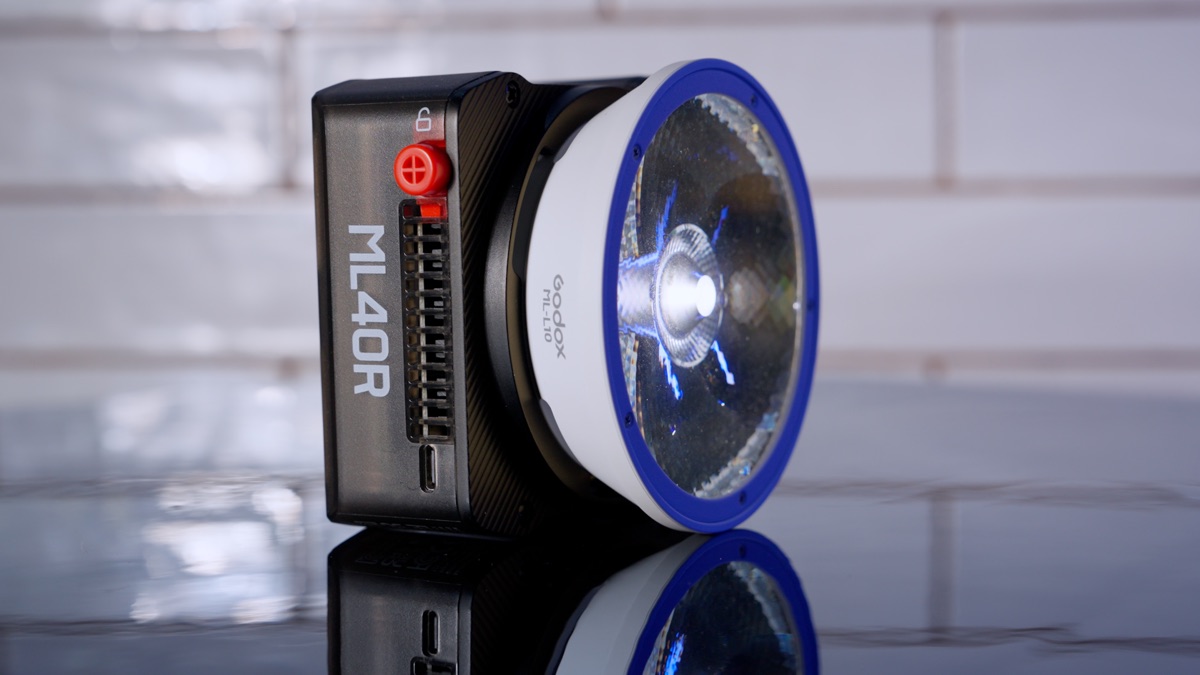
The removable lens changes the tiny fixture from a broad source into a much narrower and more intense beam.
Testing the compact lantern
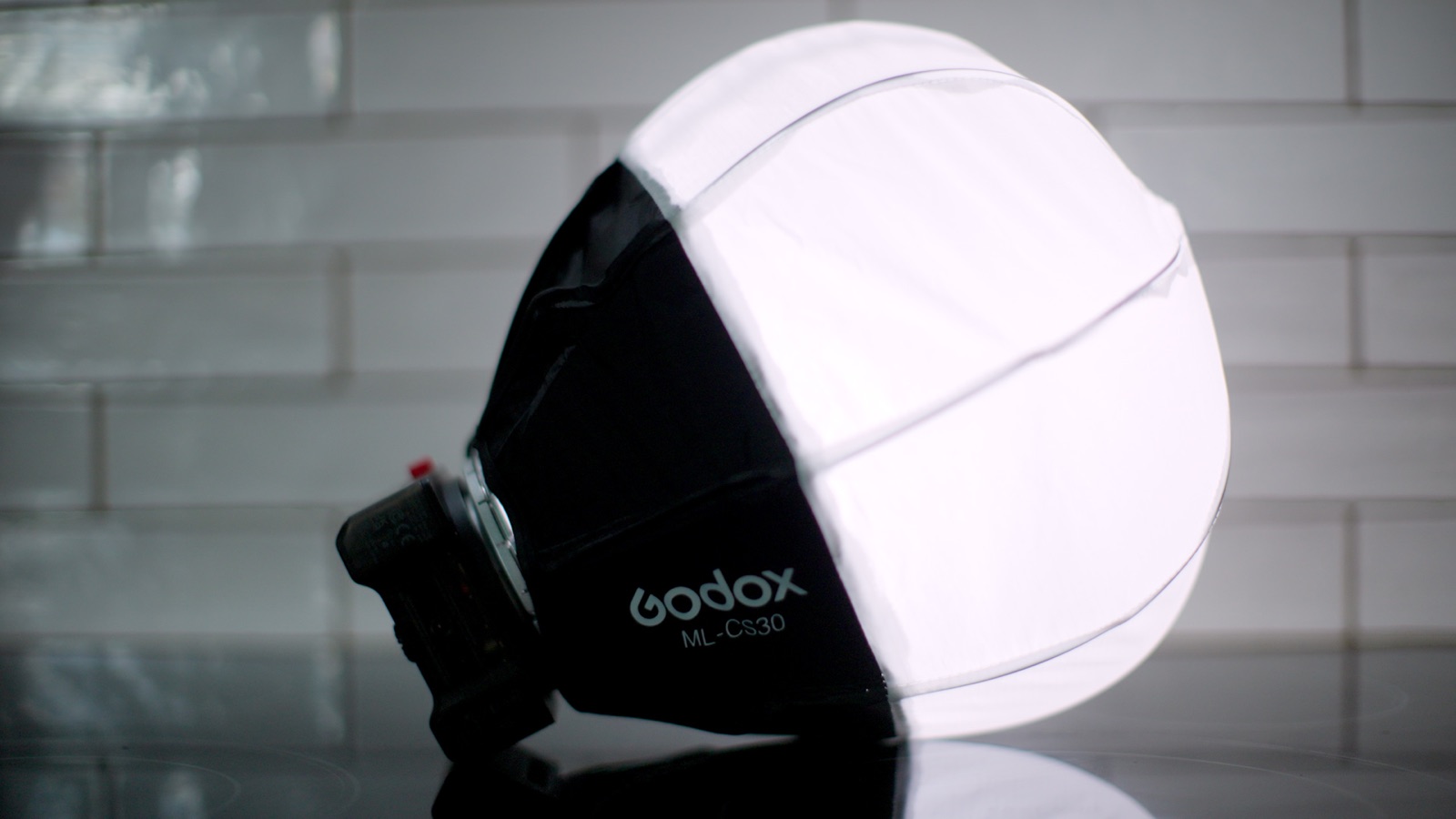
The ML-CS30 lantern was the accessory that originally grabbed my attention.
Compared with the lanterns I had been trying to fit into my kit, it was remarkably compact.
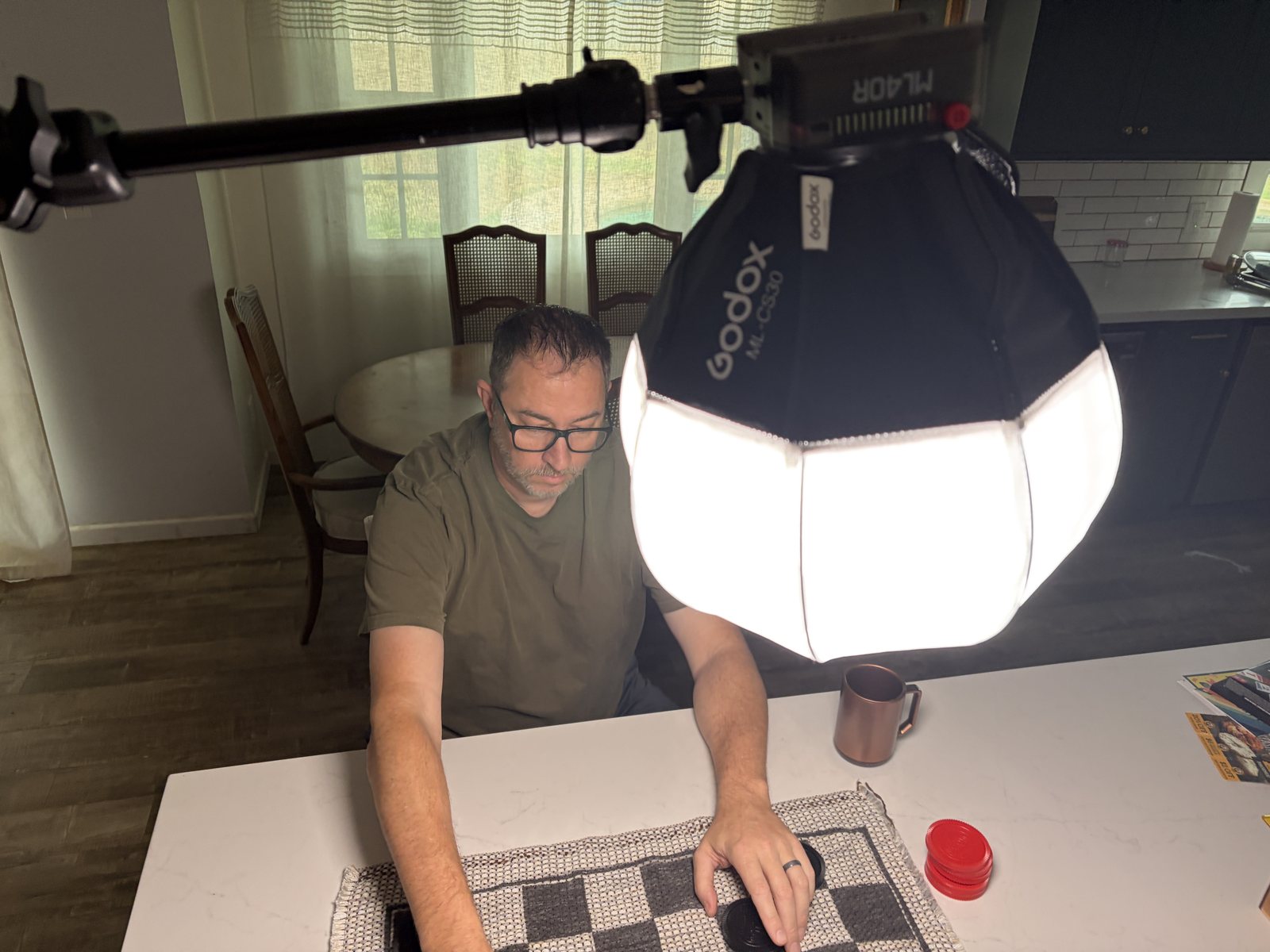
With the lantern attached, the complete setup weighed approximately 1.4 pounds. That was light enough to hang from my existing boom arm without rebuilding my support package.
For additional safety, I used a small bag of batteries as a counterweight. The setup may not have required much counterweight, but overhead lighting should always be approached carefully. The stand, boom, mounting point, weight distribution, and people beneath the fixture all need to be considered.
In the first test, I positioned the lantern close to me and raised the output to roughly 20 percent.
That added about one stop of illumination and created a soft, natural quality of light on my skin.
The source did not feel aggressive. It gently raised the exposure while wrapping around the face.
This is also why I like lanterns for workspaces and cubicles. A lantern can be positioned near a computer screen and feel as though the illumination is coming from the workstation itself. At the same time, the broader spread puts light onto the desk and surrounding environment.
The light does not simply illuminate the person.
It helps the entire workspace feel connected.
A real-world lighting test
I also wanted to see what the light could do in a more demanding setup.
For this test, the ML40R and lantern were the only artificial source in the scene.
I pointed the camera toward the windows and used ND filtration to lower the intensity of the available light. I wanted the image to feel slightly moodier while still preserving a believable relationship between the windows, the room, and the lantern.
The fixture illuminated the counter, created soft light on my face, and still reached my son on the opposite side of the setup.
Even though the camera was positioned behind him, the lantern created a visible edge along his face and helped separate him from the background.
That is a lot to ask from a fixture this small.
The result was not about overpowering the daylight. It was about controlling the available light and then allowing a compact source to shape the areas that mattered.
A possible solution for moving shots
One of the most interesting uses for this light is something I have only started exploring.
I was able to attach the ML40R and lantern to the end of a boom pole.
That could provide a useful lighting solution for moving shots.
When I follow a subject down a hallway with a gimbal, I am normally tied to the available light. There is rarely an easy way to move a traditional fixture with the subject while keeping the source out of frame.
A small, battery-powered light on a boom pole changes that.
One person could walk beside the subject with the light positioned just outside the frame while the camera operator follows with the gimbal. The source could maintain a consistent relationship to the talent instead of leaving the image entirely dependent on whatever practical or overhead lighting happens to be available.
It will not solve every moving-light situation, but it creates an option I did not have before.
And that is exactly what I want from a piece of travel equipment.
The real test of a travel light
Travel equipment always involves compromise.
A smaller light will not replace the output, control, or flexibility of a larger interview fixture. The ML40R is not going to replace the primary lights I use when I have the time and support equipment to build a full setup.
It is not supposed to.
The real question is whether a compact tool earns the space it occupies.
Does it solve a problem often enough to justify carrying it?
Does it work with the equipment already in the kit?
Can it perform more than one job?
Can it help me move faster without lowering the quality of the image?
Paired with the compact lantern, lens reflector, and optional Bowens adapter, the ML40R answers those questions better than I expected.
It gives me a soft overhead source for corporate B-roll, a concentrated beam for more dramatic lighting, a magnetic fixture for industrial environments, compatibility with existing Bowens modifiers, and a possible moving-light solution for gimbal shots.
That is a lot of versatility in a very small package.
Final thoughts
The Godox ML40R is far more capable than I expected.
The fixture itself is compact, but the accessory system is what makes it valuable. The ML-CS30 lantern solves the travel problem that kept my favorite corporate B-roll setup out of my kit. The ML-L10 lens reflector creates a completely different quality and intensity of light. The ML-GB adapter allows the fixture to work with modifiers I already own.
It will not replace my larger interview lights.
But it does not need to.
The best travel equipment is not equipment that can do everything. It is equipment that solves a specific problem without creating unnecessary weight, complexity, or delay.
For the way I work, this setup does exactly that.
The ML40R and its compact lantern have earned a permanent place in my travel kit.
Products featured:
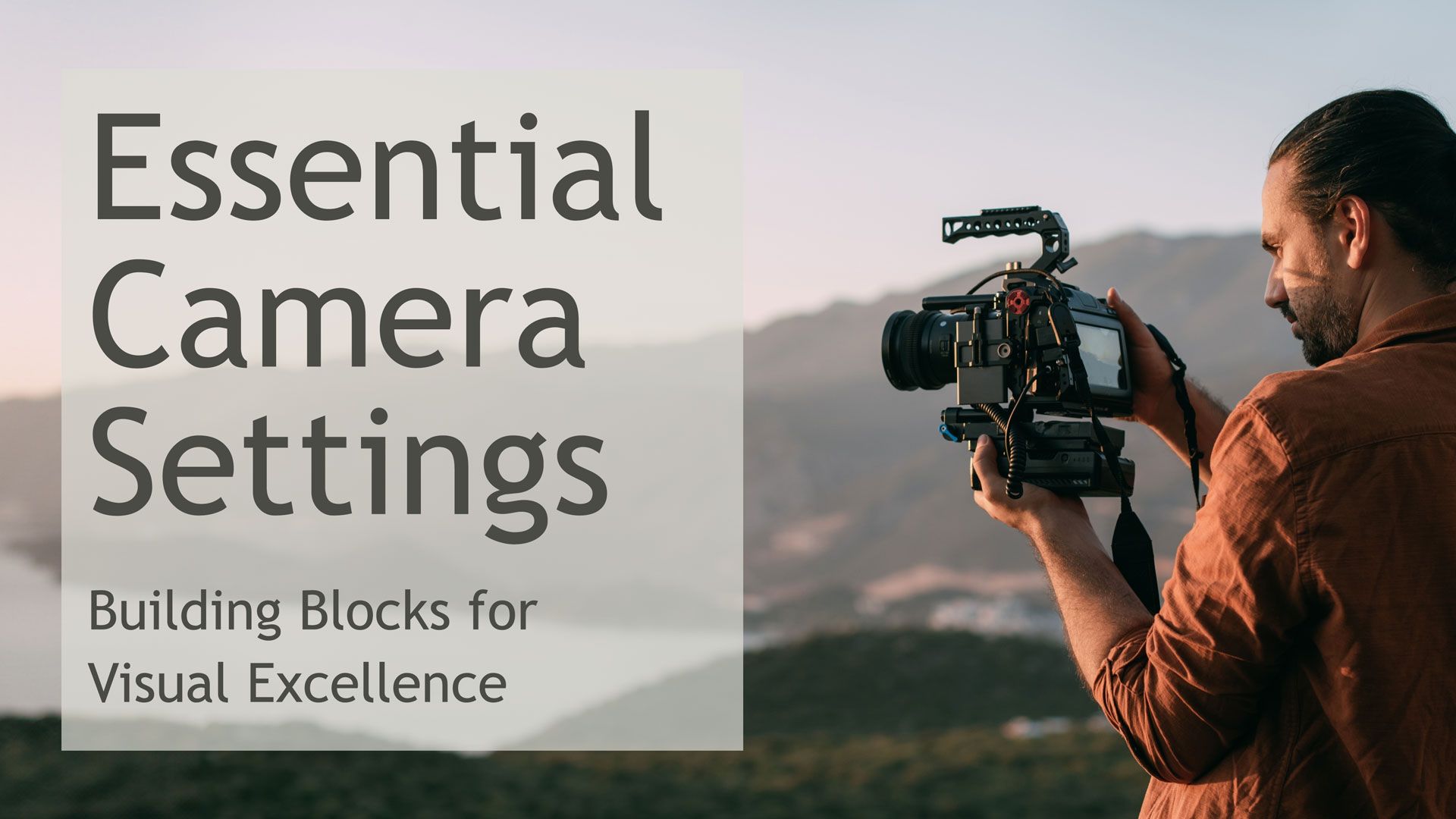
If you'd like to learn more about exposure, camera control, lighting, composition, and creating more intentional images, be sure to check out my online course, Essential Camera Settings.
by Chris Tinard © cNOMADIC 2026
Learn more about cNOMADIC's cinematography philosophy and training at cNOMADIC.com