Is the NEEWER HB80C the Most Versatile Light in My Kit?
Aug 24, 2026Is the NEEWER HB80C the Most Versatile Light in My Kit?
I already own lights that are smaller, brighter, and more powerful. But after using the NEEWER HB80C on several real productions, I found that its combination of battery power, color control, and compact modifiers kept solving problems my other fixtures could not solve as easily.
Disclosure: NEEWER sent me the HB80C for review. The opinions in this article are based on my experience using it on real productions.
When I first looked at the NEEWER HB80C, I was not convinced it had an obvious place in my kit.
It is an 80-watt RGB light, but it is not the smallest fixture I own and it is far from the most powerful. On paper, it seemed to overlap with equipment I already had.
Then I started bringing it to real shoots.
It kept fitting into places where a larger fixture would have been difficult to rig. Its internal battery let me work without searching for power. Its included modifier gave me more control than a bare compact light. And when I needed color, its gel and source modes made it quick to find a useful starting point.
That changed the question. Instead of asking whether the HB80C was the strongest light in my kit, I started asking whether it might be one of the most versatile.
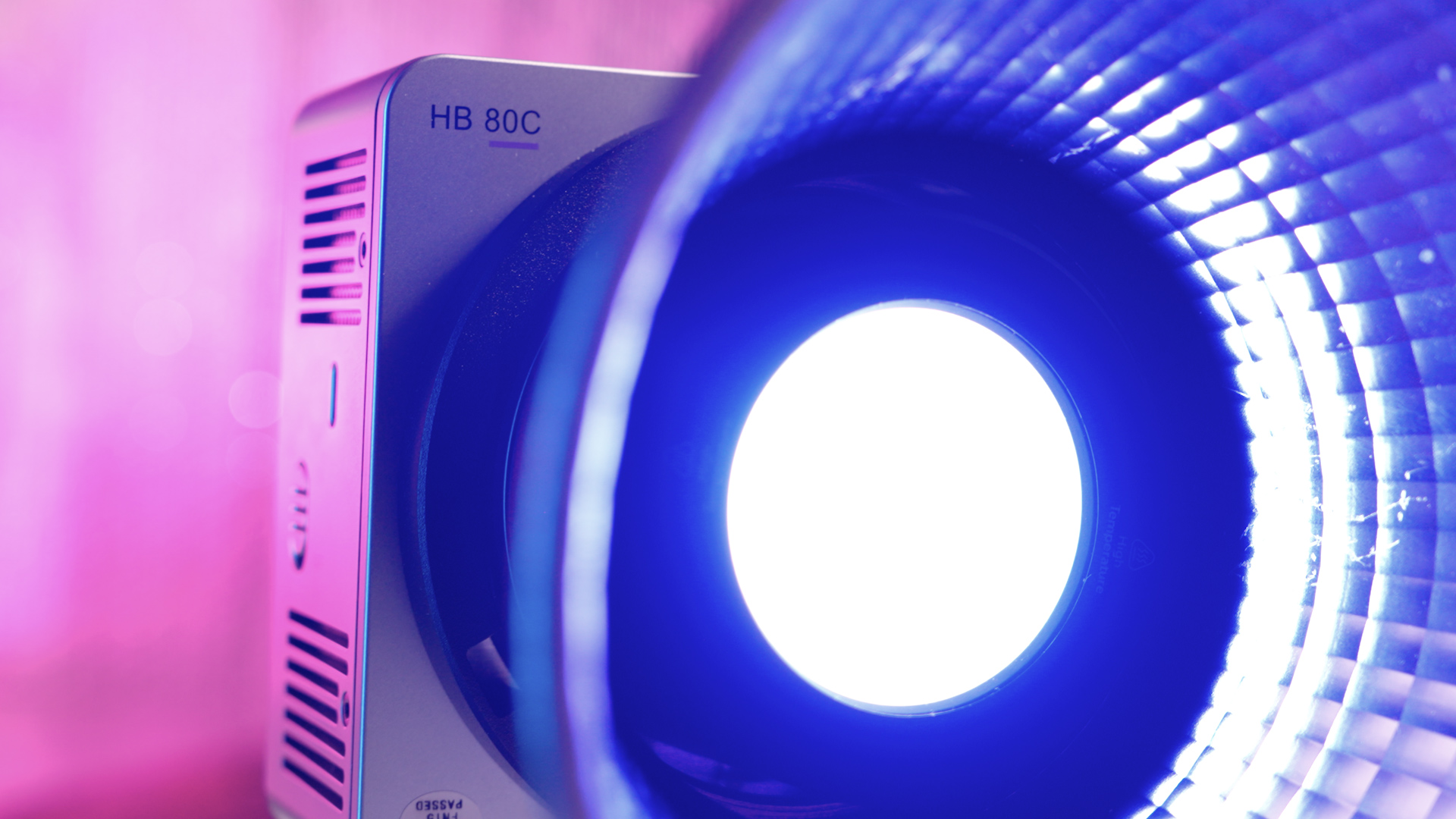
A compact light that can still work as a key
I used the HB80C as the main key light for the video itself. It was placed about six feet away and pushed through my softbox, yet I only needed to set it to 11 percent.
That was a small, dark, fully controlled room, so it was a favorable environment. Still, it demonstrated that the fixture has enough output to become a proper key when the room, distance, and modifier are working in its favor.
The included travel kit also makes the light easy to deploy. It contains the fixture, a modifier, a long USB-C cable, a tilting stand bracket, and a small tripod that can also work as a handheld grip.
My main criticism is that the small tripod cannot tilt the light by itself or connect directly to the supplied tilting bracket. I solved that with a bracket I already carry, but I believe that articulation should be included.
I usually remove new equipment from its original bag and integrate it into my hard cases. With this kit, everything fits together well enough that I have continued traveling with the supplied bag. I can place it in a suitcase or inside one of my existing production cases and know the complete setup is together.
The internal battery solves placement problems
The internal battery is my favorite feature because it changes where I can place the light.
On one location shoot, I wanted to bring blue color into the darker area beneath a staircase. The background already contained blue, but the lower level needed more separation and shape. There was no convenient outlet anywhere near the position I wanted.
With the HB80C, that did not matter. I put it on the small tripod, placed it on the floor, aimed it toward the staircase, and ran it from its internal battery.
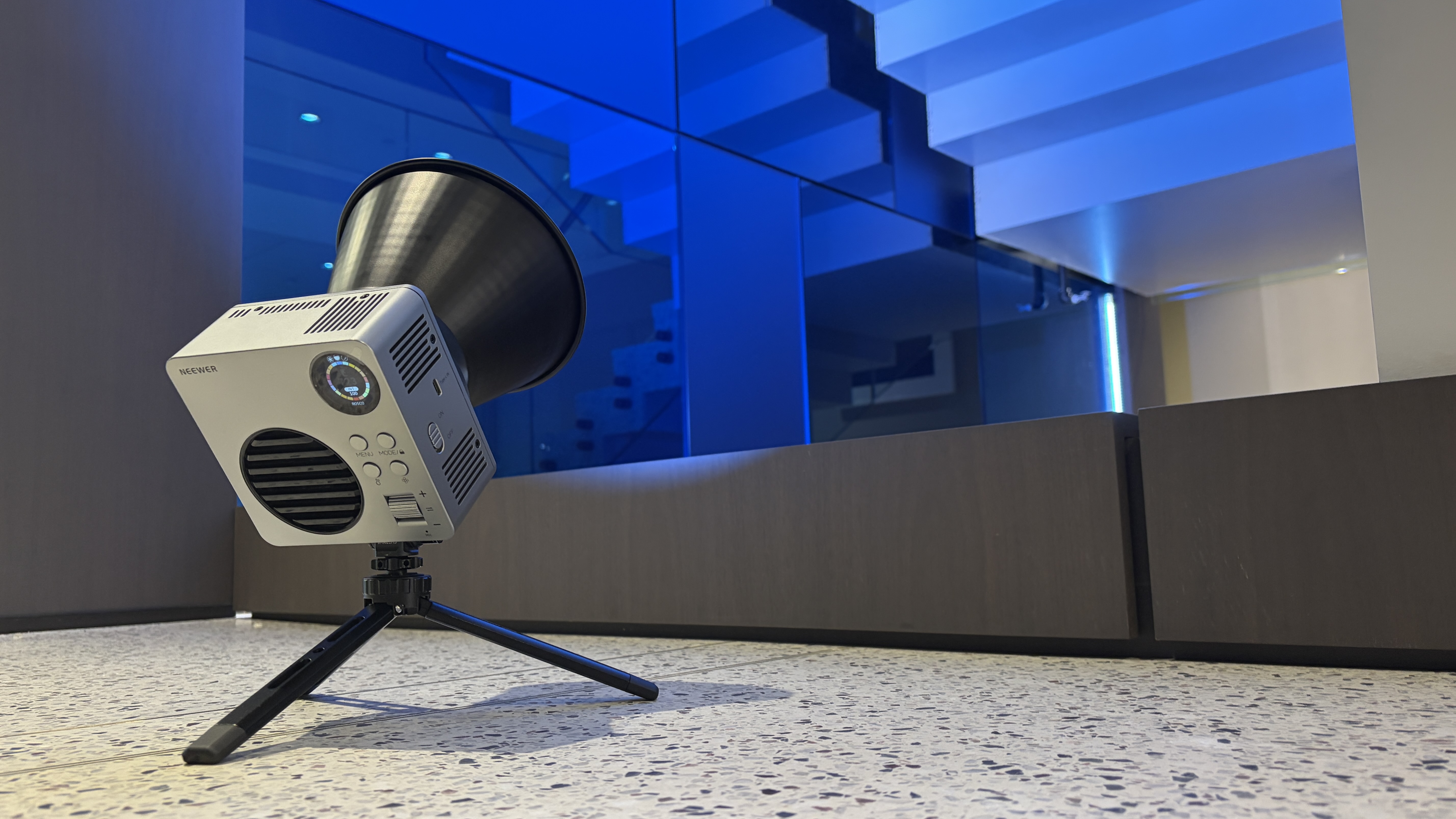
The battery can run for roughly an hour and a half at full output, but it is important to understand how the operating mode affects the available power:
- 45 watts: silent mode with the fan disabled
- 65 watts: internal-battery operation
- 80 watts: USB-C power connected to a 100-watt power source
Those differences are visible. The change from 45 to 80 watts is about one stop, while 65 to 80 watts is about half a stop. You need to account for that when deciding whether the light will be close to the subject, hidden in the background, or working across a larger distance.
Fast color control for a more distinctive interview
The HB80C includes CCT, HSI, RGBCW, gel, XY, FX, and source modes. It can be controlled from the fixture or through the app.
Source mode is useful when I want a familiar starting point. Instead of manually building a color, I can choose a preset based on a fluorescent, incandescent, candle, or daylight source.
For creative color, I especially like the visual color wheels available in gel mode. I can scroll through the wheel and judge the color visually instead of entering RGB values.
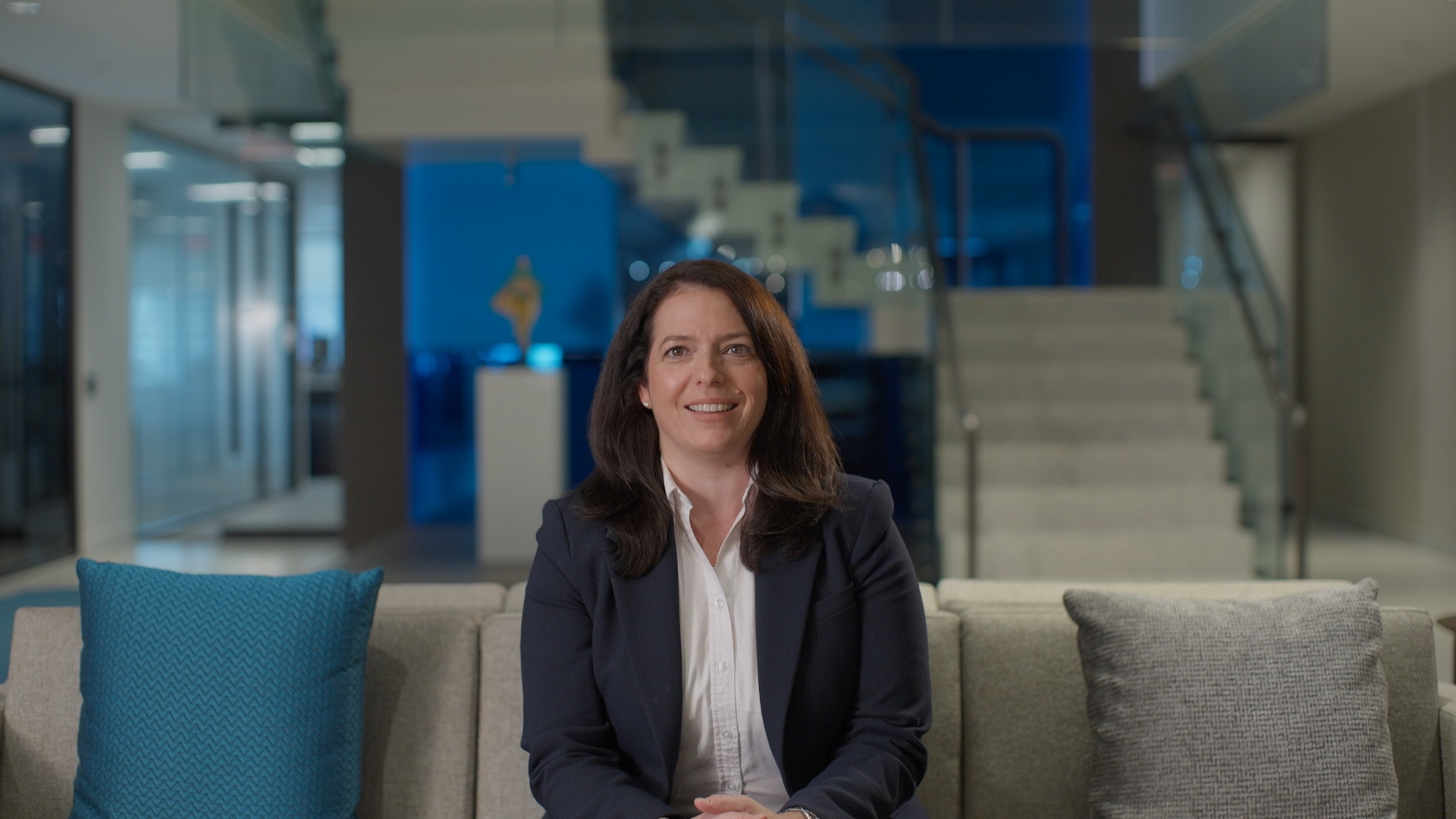
On another interview, I used that mode to choose a color for the wall behind the subject. I hid the HB80C on its small stand directly behind the chair and used the included modifier to create a tighter pool of light. That kept the wall from becoming one flat wash of color and gave the background more texture and depth.
Once I saw that background color, I decided to match the top light to it. I moved that light directly above the subject so the color would spill across her hair, glasses, face, shirt, arm, and even the chair. The result felt more unusual and a little edgier than a traditional corporate interview, and the client was very happy with it.
A punchier three-quarter backlight
I later returned to the same lobby for a different client. Because it was the same space, I wanted to frame and light it differently.
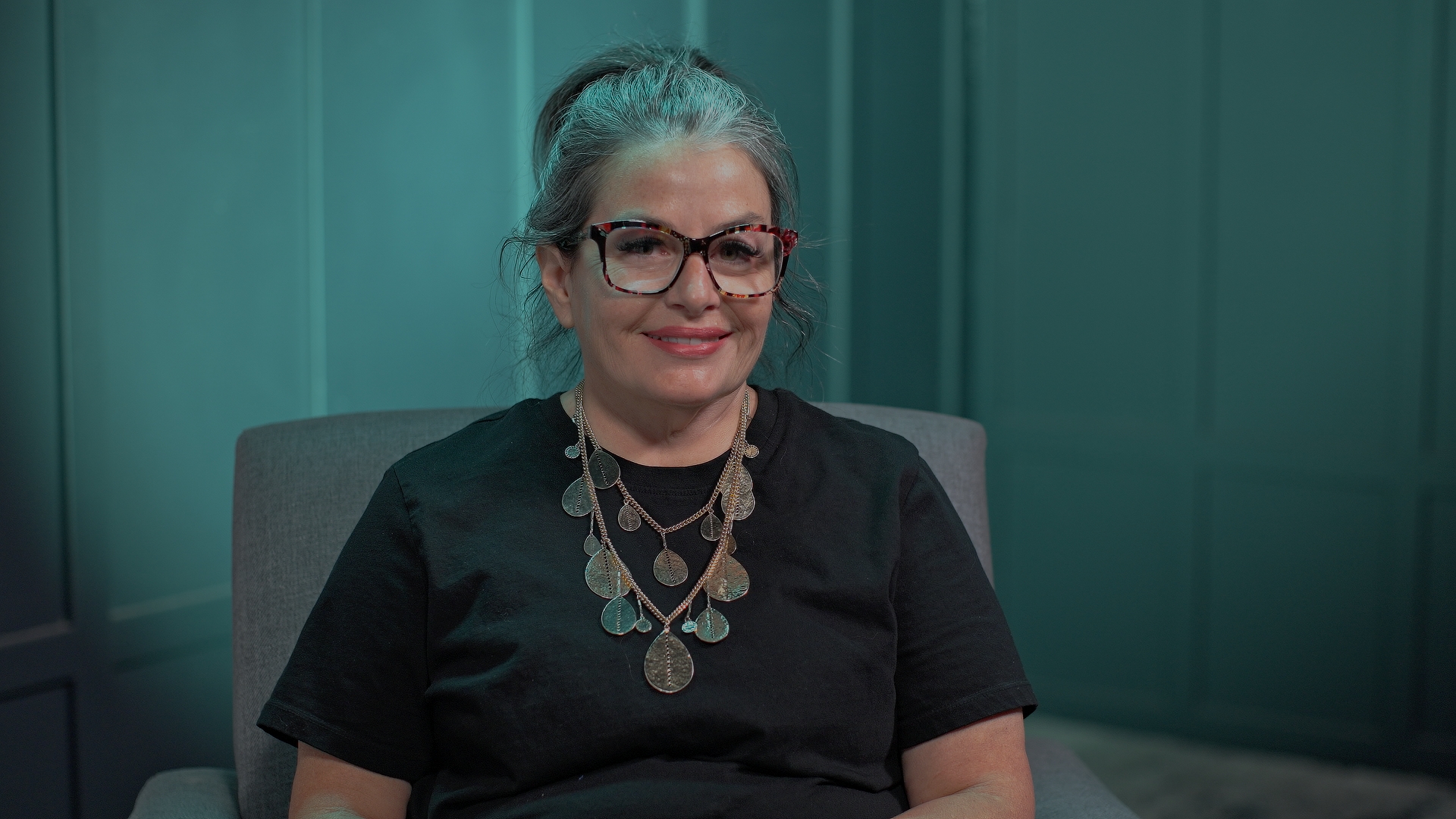
The story supported having the subject look directly into the camera, and the room offered a balanced composition: the staircase, the couch, the pillows, and the two hallways created a sense of symmetry.
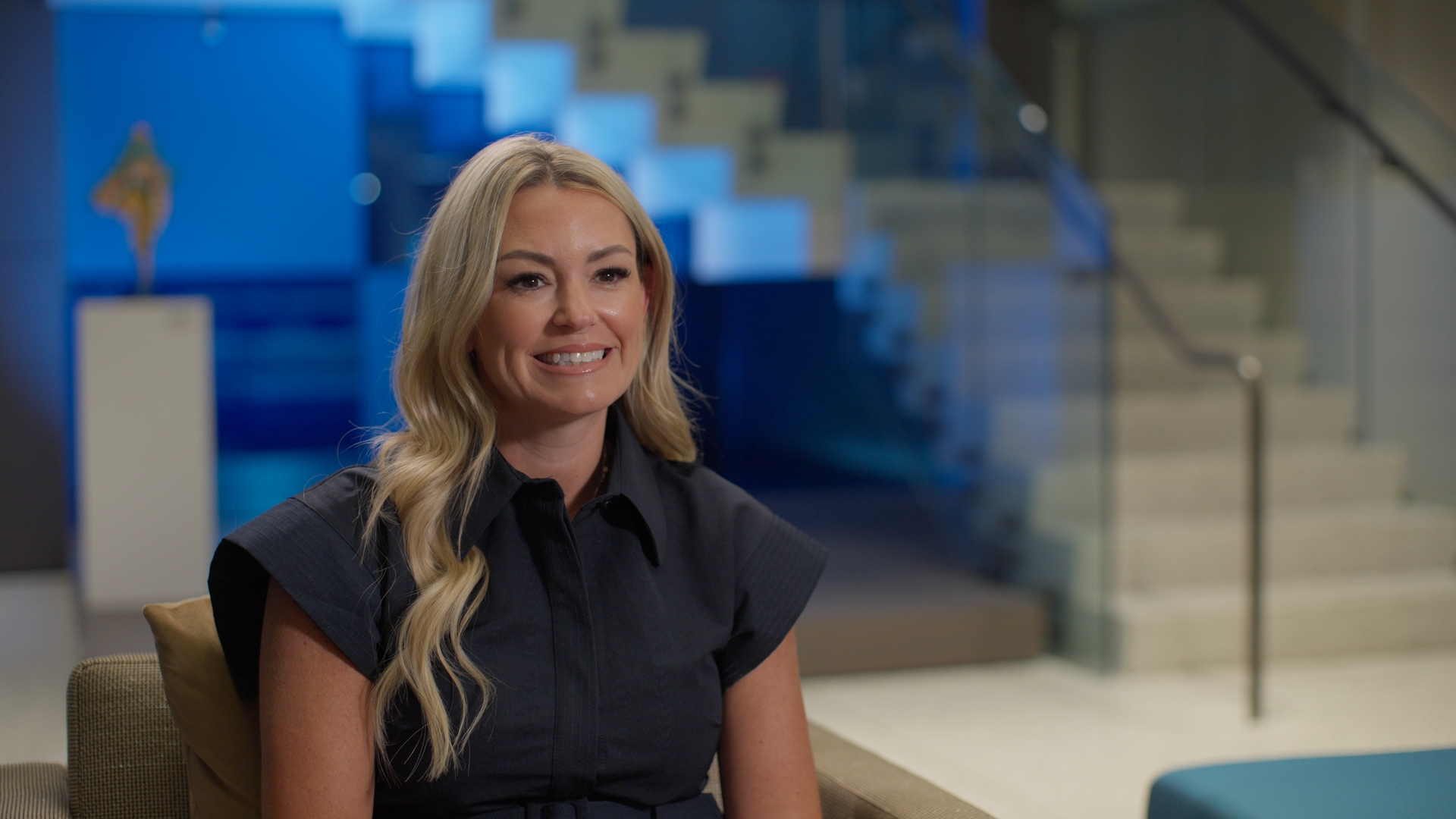
That wide frame pushed the backlight farther away from the subject. A tube light would have worked well as a close overhead source, but it did not have the punch I wanted from that distance. The HB80C, fitted with its modifier, gave me enough output to use it as a three-quarter backlight.
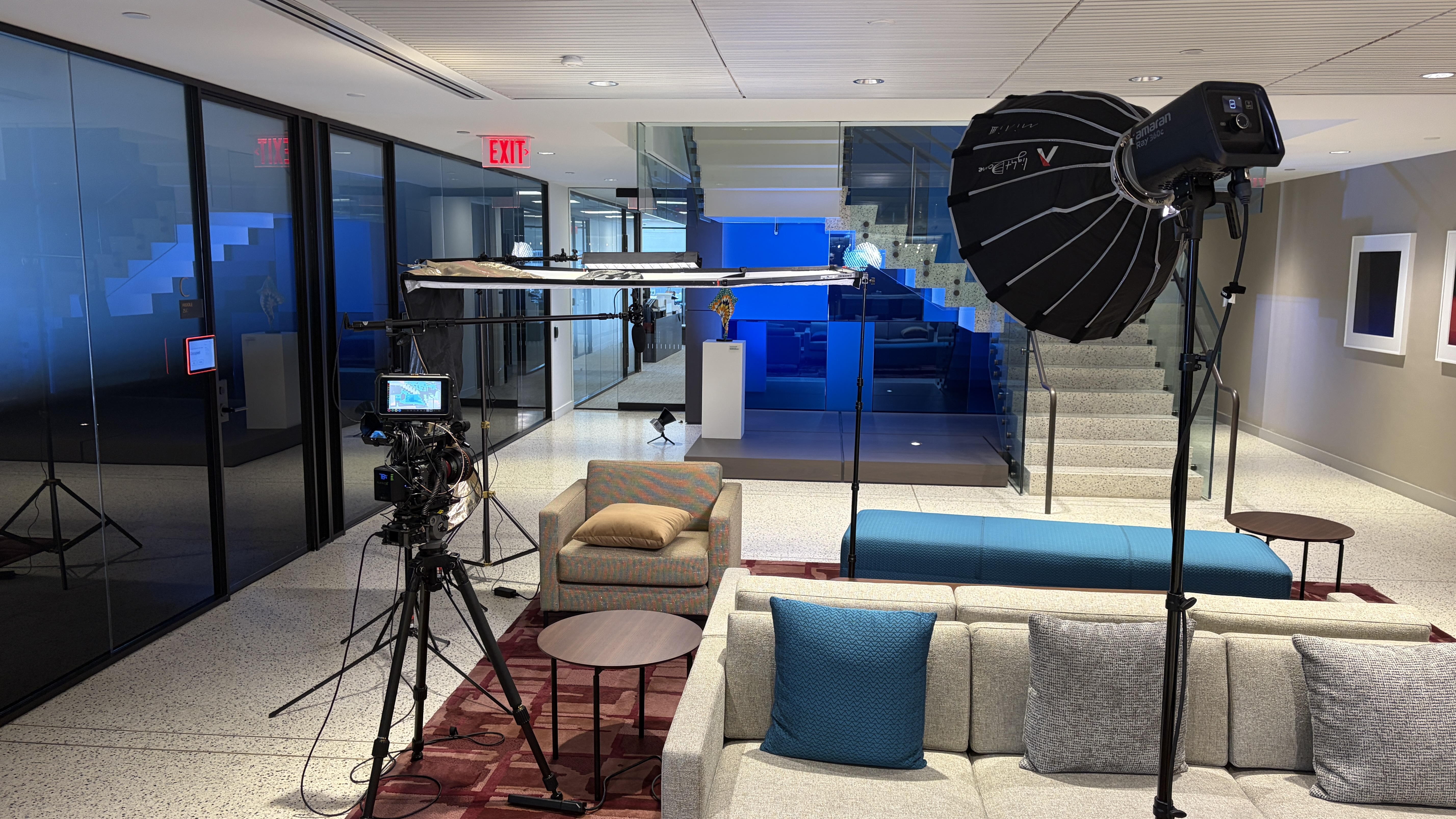
I set the HB80C to 3100K while the camera was balanced near 4100K. That difference created a warm, golden edge along the subject's hair and arm. At only 29 percent intensity, the fixture still had plenty of additional output available.
The included modifier also had a larger effect on the rest of the kit. I normally travel with one main modifier, but for this wide shot I wanted my 4-by-6-foot frame diffusion on the key. Because the HB80C brought its own modifier, I did not have to compromise the key in order to shape the backlight.
What makes this light valuable
The HB80C is not the fixture I would choose for every job. An 80-watt light has limits, and its maximum output depends on how it is powered and cooled.
But versatility is not only about maximum output. It is also about how quickly a fixture can solve different problems:
- It can become a soft key in a controlled room.
- Its internal battery lets me place it where power is unavailable.
- Its full-color modes make it useful for both matching and creative effects.
- Its compact size makes it easy to hide inside a set.
- Its included modifier can create a controlled pool or provide directional backlight.
- Its travel bag keeps the fixture, power, stand, and modifier together.
That combination has made the HB80C a genuine problem-solving tool. It does not replace my more powerful fixtures. It fills the spaces between them and often gets to work faster.
Final thoughts
Does the NEEWER HB80C belong in my kit? After using it on several productions, my answer is yes.
It has enough output for many controlled situations, but the bigger advantage is its flexibility. I can power it internally, hide it in a background, use it as a key, match an existing source, create color, or turn it into a punchy backlight.
The most valuable light is not always the strongest one. Sometimes it is the fixture that can solve the widest range of real problems without slowing down the production.
You can find the NEEWER HB80C and current product details here.
If you would like to learn more about lighting, exposure, composition, and creating more intentional images, be sure to check out my online course, Essential Camera Settings.
by Chris Tinard © cNOMADIC 2026
Learn more about cNOMADIC's cinematography philosophy and training at cNOMADIC.com.